
After the collapse of communism, the American political scientist Francis Fukuyama postulated “The End of History” in 1992. American-style liberalism had triumphed.
The “left-wing” Democrat Bill Clinton had won the US presidential election, thus ending the 12-year dominance of the “right-wing” Republicans in the US. His subsequent eight-year term went down in history as “The Unipolar Moment.” The US emerged as the undisputed sole superpower on our small planet.
Fukuyama had already hinted at the problem following this development: the dreadful boredom accompaning this state of affairs. Materially content individuals would lose their sense of challenge. Artificial culture wars would replace existential conflicts, serving to satisfy the need for struggle.
Around the same time as Fukuyama, in 1990, the American social scientist Judith Butler wrote her masterpiece: “Gender Trouble.” There, Butler argued that “gender” is not something a person “is,” but rather what they “do.” “Gender” is not a biological fact, but a social construct. The bored public finally had a topic to debate for a decade, at least in the US and Europe. Then came 9/11, the terrorist attack of September 9, 2001.
Shortly before, the Democrat Bill Clinton had been replaced by the Republican George W. Bush. His presidency would prove to be politically what had been ideologically prepared in the preceding decade: “Anything goes.” If even biologically determined facts were nothing more than arbitrary social constructs, why shouldn’t politics be able to implement this same arbitrariness?
Accordingly, the 2000s were marked by arbitrary wars, particularly against the Muslim world. These reached their peak under Barack Obama, the Democratic successor to George W. Bush. The attempt to export “liberal democracy” through coups and civil war created chaotic conditions all around Europe. Its effects can still be seen today: from Afghanistan to the Caucasus and Ukraine, from Iraq and Syria to North Africa: “Anything goes.” What an error…
Remarkably, all of the US-backed “rebels” against the prevailing conditions would ultimately turn against “liberal democracy” itself: from the Afghan Taliban, through the Iraqi Islamic State and the Ukrainian Banderistas, to the Arab al-Qaeda and the Egyptian Muslim Brotherhood – and, by the way, the Palestinian Hamas. Everywhere, the “liberal West” has found itself in a situation like Goethe’s “Sorcerer’s Apprentice”: the spirits it summoned could not be banished any more.
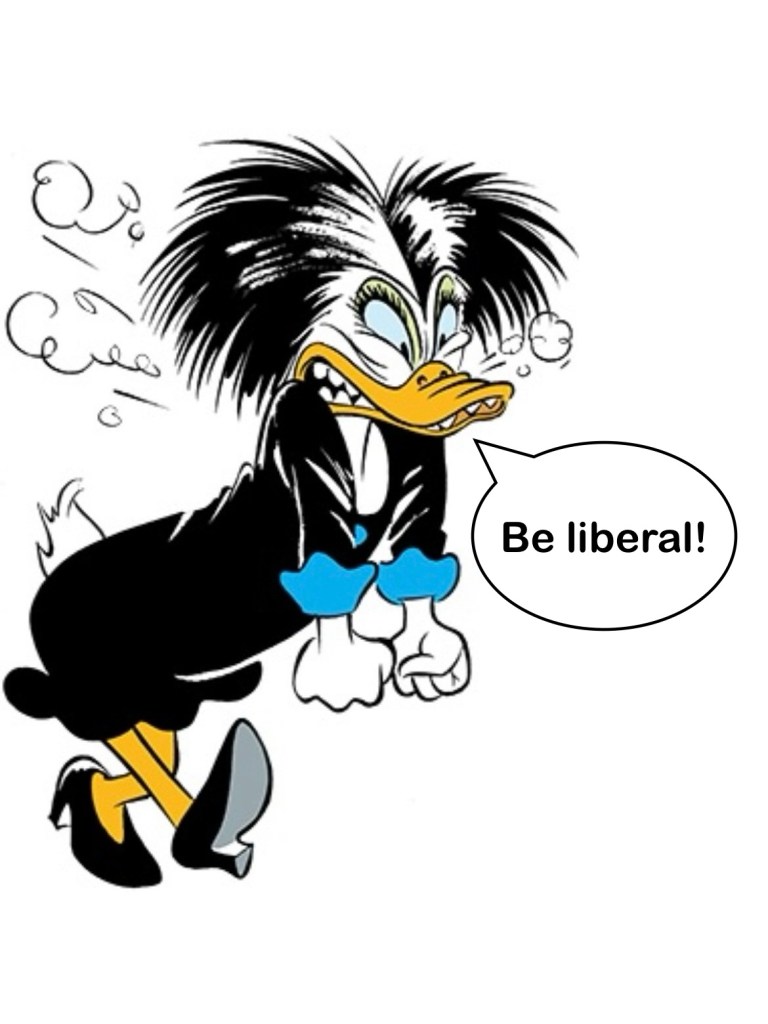
The result of this “liberal” culture war can be seen before us still today. The initially well-intentioned “freedom from all constraints” has gone beyond all reasonable bounds. The floodgates have been opened to unbridled arbitrariness. In the “liberal West,” we have dozens of “genders,” millions of “migrants,” and hundreds of types of the same “products” in our markets. The sheer endless choice in every decision overturns any established order. Yet, the impertinence of “unlimited freedom” always hits the poorest and weakest in the most brutal way. Moreover, its reign can in the long term only be maintained with “money,” which necessarily leads to “corruption” everywhere.
Now the pendulum is swinging back. Resistance against the prevailing chaos is forming all over the world—in both the political and cultural spheres. More and more people are yearning for a return to a more established order. The arbitrariness of totalitarian liberalism has come to an end. The reversal will not be pleasant.
—

