
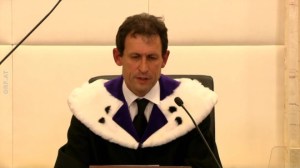
Yesterday the Austrian Constitutional Court (VfGH) decided on the law prohibiting euthanasia. It was about §77 “Killing on request” and §78 “Participation in suicide” of the Austrian Criminal Code (StGB).
The two paragraphs are as follows:
§77 StGB – Killing on request: “Anyone who kills another at his serious and urgent request is to be punished with imprisonment from six months to five years.”
§78 StGB – Participation in suicide: “Anyone who induces another to kill himself, or helps him to do so, is to be punished with imprisonment from six months to five years.”
The Constitutional Court has recognized that Section 77 of the Austrian Criminal Code, which prohibits “killing on request” and makes it a criminal offense, is fully in line with the constitution. Killing on request remains a criminal offense and is prohibited.
Concerning Section 78, which prohibits “participation in suicide” and makes it a punishable offense, the Constitutional Court has recognized that the phrase “or helps him to do so” contradicts the constitution and has to be repealed at the end of next year on December 31, 2021. Until then, the Constitutional Court gives parliament time to regulate “help to suicide”. The rest of Section 78, “who induces another to kill himself …” remains forbidden.
I took this decision of the Constitutional Court as an opportunity to write to the chairman of the Austrian Bishops’ Conference, Archbishop Franz Lackner of Salzburg:
Honourable Archbishop!
I read your reaction to yesterday’s decision by the Constitutional Court on euthanasia with great interest. You received this “with dismay” and refer to it as a “breach of the dam”. You write:
“The Constitutional Court has final jurisdiction with the highest level of responsibility. We bishops want to respect that in principle. Yet the church cannot go along with such a decision. This decision of the Constitutional Court means a cultural break.”
Dear Archbishop, let me first say that I am a “Christian”. But I am not just because I was baptized as a newborn. I am for one reason only:
I believe in the sanctity of life from conception to death.
“Christianity” basically places its mission in the reconciliation of man with the “God” of the Jewish tradition. And we do this from the beginning to the end, from the Alpha to the Omega, from the “Conception by the Holy Spirit” to the “Resurrection”.
Now the question is how to understand both the “Conception by the Holy Spirit” and the “Resurrection” of Jesus of Nazareth. Church history over the past two millennia testifies how we have tried to do this over time. I myself agree with both living Popes to do this with love and compassion, from “Deus Cartitas Est” to “Caritas in Veritate” and “Laudato Si” to “Fratelli Tutti”.
In this sense, our mission succeeds in the reconciliation of people with God, but also of all people with one another, from the Jewish “Here I am” (Ex 3,4) to the Muslim “In the name of Allah, the All Compassionate, the Most Merciful” (Sura 1, 1). We don’t believe in pointless coincidence. We trust in the love and mercy in this world – from beginning to end. We are all transcendental optimists, in love and brotherhood.
So I come to your reaction to the VfGH. “God” gave us humans liberty. The price for this was the fall from paradise. The decisive question since then has been: Do we humans have the right to kill another human when in doubt? God gave us this freedom.
In this context one could cite an infinite number of examples, from the fratricide of Cain to the murder of Moses to the assassination attempt by Stauffenberg against Adolf Hitler. We decided it was better not to kill and to forbid this as a matter of principle.
So, does man have the right to kill himself when in doubt? God has given us this freedom too. This is where the answer becomes crucial.
From “Conception by the Holy Spirit” to “Resurrection” we are confronted with our freedom, from abortion to euthanasia, from assisting in abortion to assisting in suicide. May we do that? Shall we do that?
You are writing that the church “cannot go along with” the decision of the constitutional court. We don’t need to. In the enlightened constitutional state, the separation between state and religion is based on the separation of law and morality. The state decides on what is “allowed”, religion decides on what is “ought”. Just because helping to commit suicide in the future – like help with abortion so far – is exempt from punishment does not mean that it has to be morally desirable.
How do we as Christians want to deal with it? As I said, I share the view with Popes Benedict and Francis that we should try to do this with love and brotherhood, with affection and compassion. In this sense, I consider yesterday’s finding by the VfGH to be well differentiated. Inducing to commit suicide remains prohibited by all means, helping to commit suicide does not. What does this mean for us Christians? How do we deal with this in our belief in the “Resurrection”?
Euthanasia openly reveals the conflict between “may” and “should”. As Austrians, we are basically allowed to kill ourselves and, in the future, help others in case of doubt. As Christians, however, we shouldn’t.
Then we don’t do it. We don’t have to. Where is the problem?
The problem is only a moral problem within ourselves. What is our general position on suicide? And so, in conclusion, I ask you only one final question in this context:
Dear Archbishop, do you believe that Judas, after his suicide, meanwhile has been accepted in heaven?
All the best
Peter H. Wurm
—
See also:
—

