
The war in Ukraine is a World War. It’s not only a war about two provinces in eastern Ukraine, the Donbass, it’s a war between different economic systems. Some say, it’s a war between Democracies and Autocracies. This is not the case. It’s a war between Market Economics’ winners and its victims. It’s a war between the rich and the poor. It’s a war between „The West“ and „The Rest“.
What is happening right now? Let’s watch what’s going on in the world. Let’s watch global economic policy. Let’s watch global currency policy.
At the core, global currency policy is all about exports and imports. A country has always the choice between two bad options: A weak currency favours inflation, because all imports are getting more expensive for oneself. A strong currency favours unemployment, because exports are getting more expensive for the others.
If a country wants to strengthen its economy, it will try to increase its exports. So it will try to keep its currency „weak“. If a country wants to slow down its economy because of the threat of inflation, it will try to keep its currency “strong“.
During the last decade, after the breakdown of Lehman Brothers as spark of the financial crisis, the European Union had tried to keep its currency weak – as weak as the US-Dollar. Europe did not face a threat of inflation. On the contrary, Europe faced a threat of deflation and stagnation – because the USD was so weak. Therefore the European Central Bank did everything to keep the EUR on a low level. It was doing “whatever it takes to preserve the Euro“, as its President Mario Draghi said in his decisive 2012 speech in London. The ECB was therefore buying bonds of member states and held its interest rates even below zero.
The Covid-19-pandemic accelerated this problem. The whole world came to a standstill. All countries needed money to pay their citizens, but production slowed down massively due to lockdowns. Now, that the worst of the pandemic seems to be over, everybody is eager to come back to normal. The threat of inflation has become real.
To understand what’s going on in the world economically, let‘s start with Europe. For this purpose, we are now concentrating on the poorest part of Europe. We are concentrating on South Eastern Europe. We are concentrating on the Balkans.
The Balkans are divided into the “Eastern Balkans“ (Romania 🇷🇴 and Bulgaria 🇧🇬) and the “Western Balkans“ (former Yugoslavia and Albania 🇦🇱). Former Yugoslavia consists of 6 former Yugoslav provinces (Slovenia 🇸🇮, Croatia 🇭🇷, Bosnia and Herzegovina 🇧🇦, Serbia 🇷🇸, Montenegro 🇲🇪 and Northern Macedonia 🇲🇰) plus Kosovo 🇽🇰. Quite a lot…

The blue states are Euro-countries, meaning they have the EUR as their currency. The light-blue countries are EU-members with their own currencies. The light-grey countries are states outside the EU and the dark-grey countries are the “Western Balkan“ countries.
Inside the Western Balkans two countries accept the EUR as their official currency: Montenegro 🇲🇪 and Kosovo 🇽🇰.
Let’s have a look at the developments in course of the Ukraine crisis. Let’s see what has happened in Europe after Russia had started its „special operation“ in Ukraine. Let’s see what has happened since February 24:
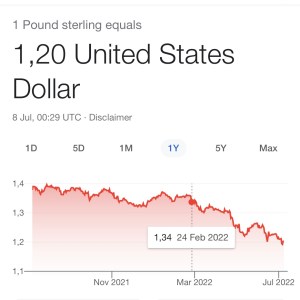
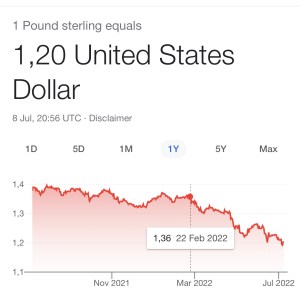
On February 24, the GBP (the British Pound Sterling) began to decline:
—
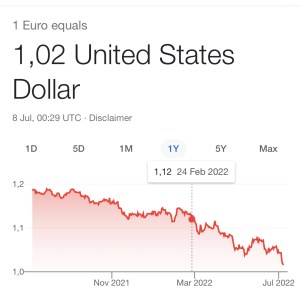
The EUR had no other chance than to follow:
—
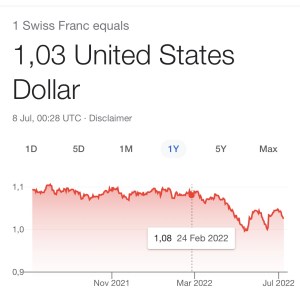
Even the CHF (the Swiss Franc) could not hold its level:
—
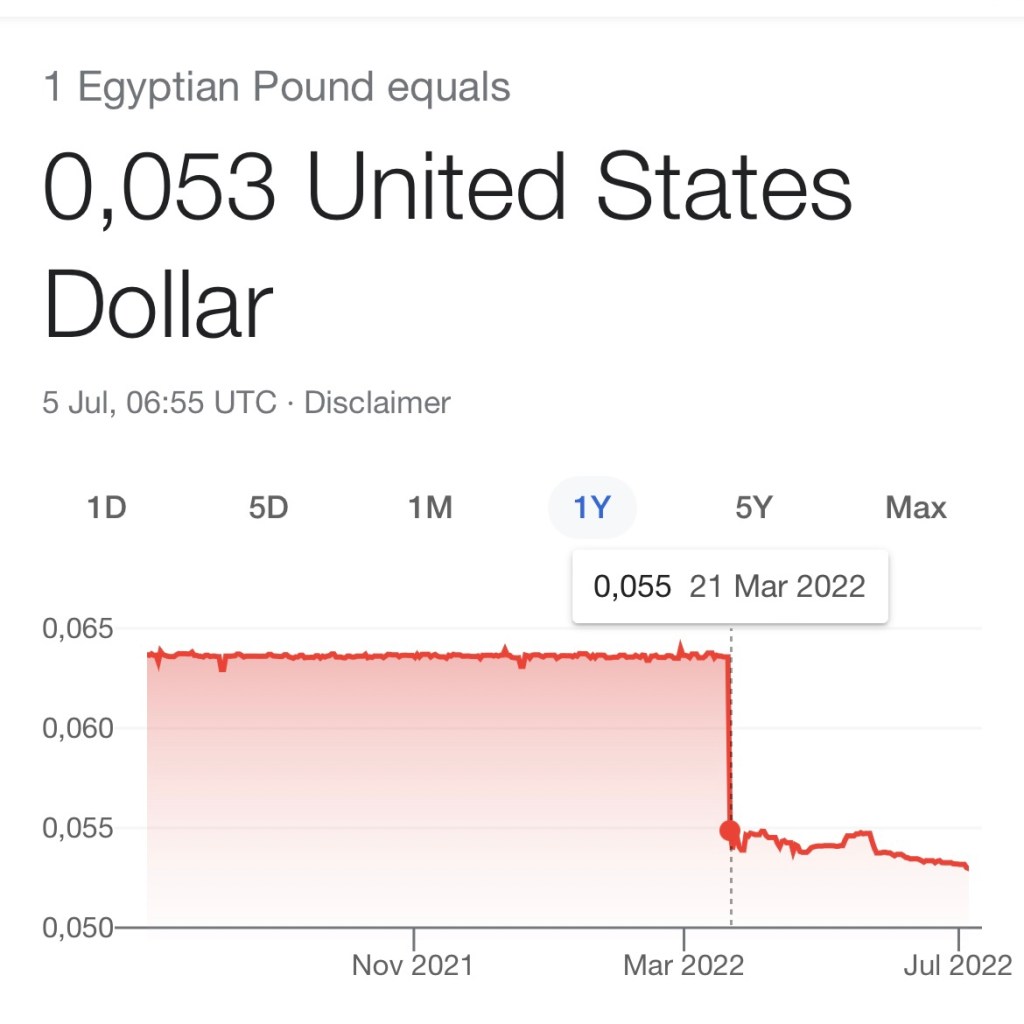
Four weeks later we saw the first major victim of this development: The Egyptian Pound. Egypt had to terminate its tie to the USD. The EGP is declining ever since:
—
One month after the collapse of the EGP the second largest economy in the world, the People’s Republic of China, decided to devalue its currency, the CNY (Chinese Yuan) accordingly:

—
Let’s watch this development from an European perspective. Let’s watch it based on the EUR:

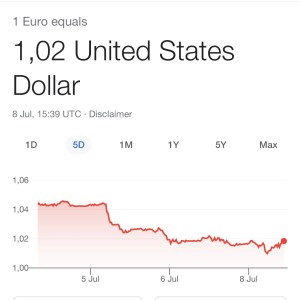
Logically, as the Euro is declining against the US-Dollar, the USD is rising against the EUR. Meanwhile the USD has nearly reached parity to the EUR, meaning their exchange rates are now nearly 1:1.
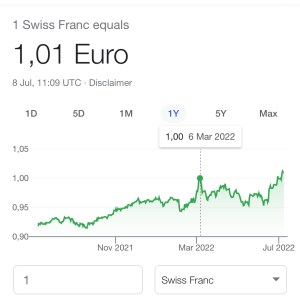
The Swiss Franc had reached its parity to the Euro already on March 6. It was its highest value during the year. After this peak it stabilised just below this barrier to break it again this week:
—
What does this mean for the European Union? Let’s watch the inner European exchange rates. Let’s have a look at the Eastern European countries:
Czech Republic 🇨🇿:

—
Poland 🇵🇱:
—
Hungary 🇭🇺:
—
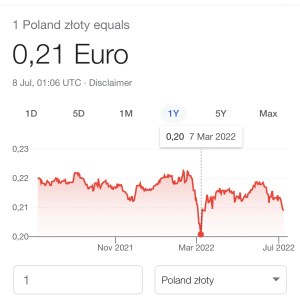
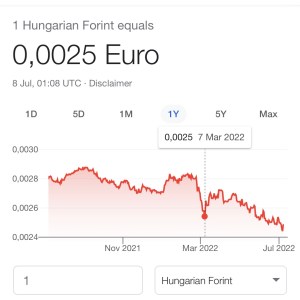
Exactly at the time of the peak of the Swiss Franc, the Eastern European countries Czech Republic, Poland and Hungary came under pressure. What a coincidence… The Czech Republic reached its low on March 5, Poland and Hungary two days later. Together with Slovakia these countries are forming the four “Višegrad states“ inside the EU. (Slovakia is the only one having the EUR as its currency.) Czech Republic doesn’t have a border to Ukraine, the three others do.
What does this mean economically? Let’s have a look at Ukraine again:
Ukraine 🇺🇦:

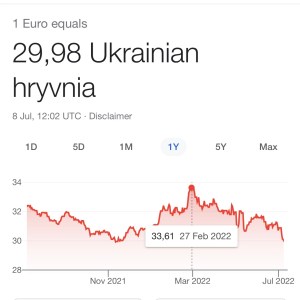
Different to all other countries in the region, Ukraine did not lose ground. On the contrary, on February 24, Ukraine began to stabilise. Since then its currency is tied to the US-Dollar at a rate of 0,34 USD (meaning one third of a Dollar).
Accordingly, the Eastern European countries have got a problem now. The countries bordering Ukraine have been devaluating their currencies ever since:
Poland 🇵🇱:

The Polish Zloty began to decline from February 25 on.
—
Hungary 🇭🇺:

Exactly so, even more, did the Hungarian Forint.
—
Slovakia 🇸🇰:
And so did the Slovak Euro, two days later.
—
The weakest currency of all three is the Hungarian Forint. Its exchange rate declined even against the Polish Zloty, and certainly against the EUR.
So what does this mean for the Balkans? Hungary is bordering Slovenia, Croatia, Serbia and Romania. Let’s take a closer look at this situation:
On the Eastern Balkans, Romania and Bulgaria are members of the EU, but have their own currencies. Let’s have a look at them:
Romania 🇷🇴:
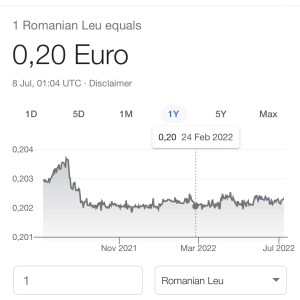
The Romanian Leu has come under little pressure to upgrade its value since February 24, but has still held its firm tie to the EUR at about 0.202 EUR.
—
Bulgaria 🇧🇬:
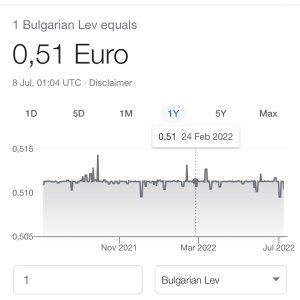
The Bulgarian Lev is a little less stable, but resisted all attempts to upgrade against the Euro. Its exchange rate is stable at 0.512 EUR.
—
On the Western Balkans 4 countries are using the EUR as their currency. Slovenia 🇸🇮 is members of the Eurozone inside the EU, Croatia 🇭🇷 will join on January 1 next year, and Montenegro 🇲🇪 as well as Kosovo 🇽🇰 are using the EUR as their official currency.
That leaves 4 countries with their own currencies: Albania, Bosnia and Herzegovina, Northern Macedonia and Serbia. Two of them still have a currency tied to the EUR: Bosnia and Herzegovina 🇧🇦, as well as Northern Macedonia 🇲🇰:
Bosnia and Herzegovina 🇧🇦:
Bosnia and Herzegovina has an artificial currency, the so called “Convertible Mark“. It was created after the end of the Bosnian War according to the Dayton Peace agreement. It used to be fixed to the German Mark (DEM) and has been fixed to the Euro since its invention in 2002. According to the value of the former DEM it’s worth exactly 0.51 EUR.
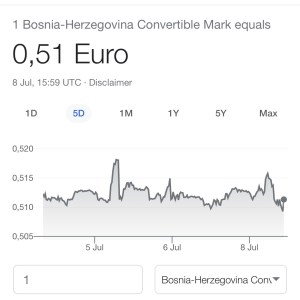

As we can see it’s floating during the day, but remains fixed at 0.51 EUR since June 19, 2020 at all costs:
—
Northern Macedonia 🇲🇰:
Different to Bosnia and Herzegovina, Northern Macedonia has its own independent currency, the Denar. Yet, it is tied to the EUR in a very limited range:
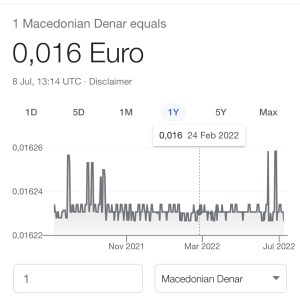
As we can see, there is much speculation going on there. “The markets“ obviously want to upgrade the Denar against the Euro.
—
This leaves two Western Balkan countries with free floating exchange rates: Albania 🇦🇱 and Serbia 🇷🇸:
Albania 🇦🇱:
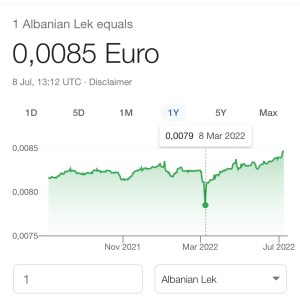
Albania saw its lowest value (together with the Višegrad countries) shortly after the Russian invasion in Ukraine, on March 8. But different to Poland and Hungary it was able to bounce back strongly and has increased its value against the EUR ever since.
—
Serbia 🇷🇸:
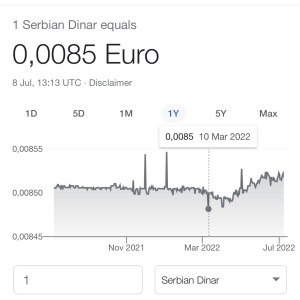
Serbia‘s Dinar (RSD) saw its lowest value also two weeks after the Russian invasion into Ukraine, exactly on March 10. Since then it has increased its value against the EUR to the top.
—
Let’s have a quick look back at Serbia‘s northern border. Let’s have a look at the relationship between Serbia and Hungary. Let’s have a look at their charts:

The Hungarian Forint (HUF) didn’t fall from February 24 on, like all other currencies. The HUF lost ground against the Serbian Dinar (RSD) even two days before. Somebody must have had a good nose…
—
What conclusion can we draw out of these charts? What do they mean? Altogether it means that the Euro is coming under pressure. The EUR loses ground against all of the Western Balkan countries, meaning investments in this area are getting more expensive. And everything is played out on the weakest area of the European Union, at the Hungarian-Serbian border.
“The markets“ obviously want a weak EUR, forcing the European Central Bank to take tough measures.
How do “the markets“ do this? Let’s have a look at the 4 “Black countries“ described in the last article:

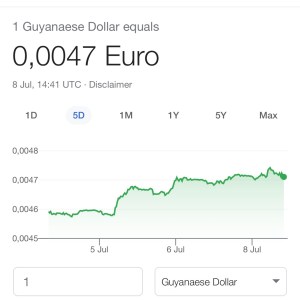
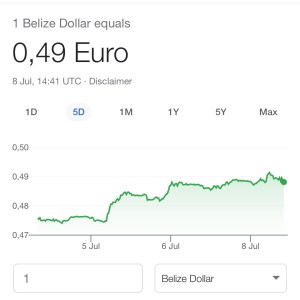
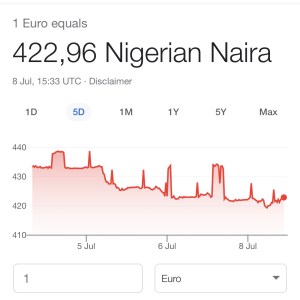
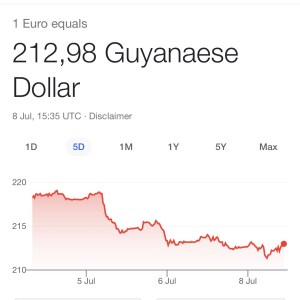
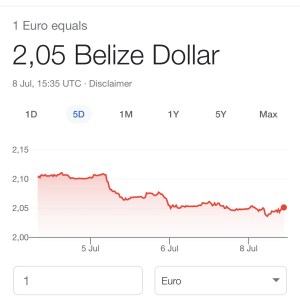
These four countries are Papua New Guinea 🇵🇬, Nigeria 🇳🇬, Guyana 🇬🇾 and Belize 🇧🇿. All four are part of the British Commonwealth, and yet tied to the US-Dollar. What has happened there during last week? Let‘s have a look:
Papua New Guinea 🇵🇬:

—
Nigeria 🇳🇬:

—
Guyana 🇬🇾:
—
Belize 🇧🇿:
—
You can see how easily “markets“ are made. With very little effort in these seemingly unimportant countries you are able to influence the whole world.
On the reverse it means that the EUR is losing ground accordingly:

—
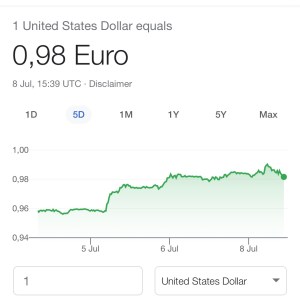
So, what happened to the two currencies involved? What happened to the US-Dollar and the British Pound during last week? What happened to the USD and GBP compared to the EUR?

—
Both the US-Dollar and the British Pound were rising. They were rising accordingly. Everybody can follow the charts, everybody can see how things develop. ”The markets“ are nothing abstract. „The markets“ are nothing “objective“. Markets are man made, and there is no “invisible hand“. It‘s all too visible.
—
To understand, what catastrophic consequences are following out of this, you just have to look at the charts again:. Let’s have a look at just one currency. Let’s have a look at the second biggest economy in the world. Let’s have a look at China:
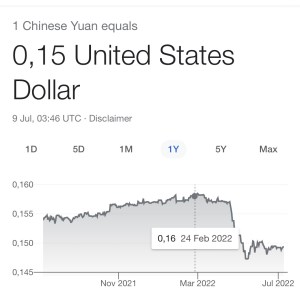
As we saw before, China devalued its currency massively in the course of last year. Chinese goods are getting much cheaper, while China itself risks massive inflation. But what does that mean for Europe? Let’s have a look:
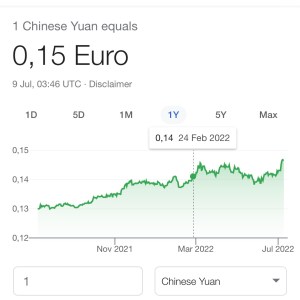
While all chinese goods are getting much cheaper for the US, they are getting more expensive for the rest of the world, especially Europe. The Chinese Yuan is at its highest value of last year compared to the EUR.
—
“The markets“ have decided: The UK and the US want Europe to pay. Volodymyr Zelenskyy is just their useful idiot. Let’s dress warmly. It’s gonna get tough.
—
By the way, the British Pound started to decline already two days before February 24, too. Somebody must have had a really good nose…
—
In commemoration of Mohammad Barkindo and Shinzo Abe.
—
 Vienna Calling