
As humans, we basically have two options. Either we believe in pointless coincidence or we believe in some meaning of this life. But if we believe in a meaning in life, then consequently everything in life must also have a meaning, even if we do not understand this meaning at first. At least there could be a meaning of the seemingly meaningless to learn from it.
At the moment we are all affected by the coronavirus pandemic. It is the first time in human history that something affects us all at the same time. If this pandemic should have any meaning, then we must first try to understand it. This pandemic affects all of us in the world for the first time at the same time. But how?
The following analysis shows the effects of the pandemic on the largest nations in the world, the so-called G-20. (The sources are the WHO and the IMF, as well as the Statistical Offices of the single countries.) What are the consequences of the pandemic for health and the economy worldwide? And what would be the meaning?
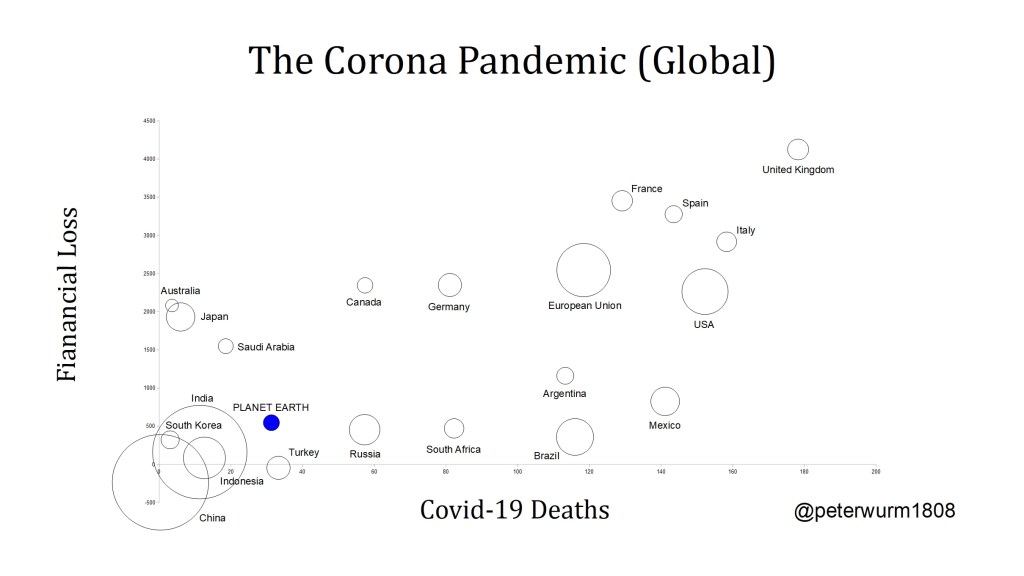
In order to understand the consequences of the pandemic, we put the health and economic consequences on earth in relation to each other. On the horizontal X-axis, we see the health effects up to now (the deaths per hundred thousand inhabitants up to February 22, 2021). On the vertical y-axis we see the economic impact up to now (the decline in GDP per inhabitant in US dollars in 2020). The further to the right a country is, the more it has to suffer from the health effects and the further to the top it is, the more it is affected by the economic impact.

So here we see the 20 biggest countries in the world. Which states are far to the right? And which states are high up? And where is planet earth as a whole? So far, the pandemic has cost the earth 31 lives per hundred thousand inhabitants and (with a shrinking global economy of 4.9%) an average of 545.80 US dollars in annual income per inhabitant. Planet Earth on the whole therefore lies in the lower left area of the graph. The People’s Republic of China and Turkey are the only two G-20 countries whose economy grew slightly over the past year, therefore they are even below the X-axis.
To further illustrate this picture, let’s next look at the countries according to their economic size:

The largest economy in the world is the USA, followed by the EU and the People’s Republic of China. You can see that the western industrialized nations are hardest hit, both regarding health and economically. The average country on planet earth would have an economy between the size of Turkey and Argentina.
To better understand the situation regarding to health, let’s look at the individual states according to their population. (This is the basis for the horizontal X-axis.)
The most populous country in the world is the People’s Republic of China, followed by India and the European Union. Here the basis of the health consequences becomes apparent. The populous countries in the east of the world have so far been least affected. The average country on planet earth would have a population the size between Argentina and Canada.
Finally, to further illustrate the economic consequences, let’s look at the countries according to their financial wealth. (This is the basis for the vertical Y-axis.)

The USA is at the top here, followed by Australia and Germany. This is where the basis of the economic consequences becomes apparent. The rich countries of the industrialized world are hardest hit. If the earth were an average country, its citizens would be slightly poorer than an average Russian and slightly richer than an average Chinese.
So what did we see? The coronavirus pandemic hits the rich industrialized countries of the west the most. We pay twice here, firstly with the most deaths and secondly with the biggest financial losses. And so we return to the meaning.
What do we learn from this?
Our wealth is reaching its limits with full force. Maybe we will become more humble overall, especially in our financially wealthy countries. Maybe we learn that it may also be more moderate. Maybe it doesn’t always have to be “more”, maybe sometimes it can be “less”. Maybe unlimited “economic growth” is not the ultimate goal. If we just learn that, then this pandemic may have made sense.
—
 Vienna Calling